Article
Designed for the Feed
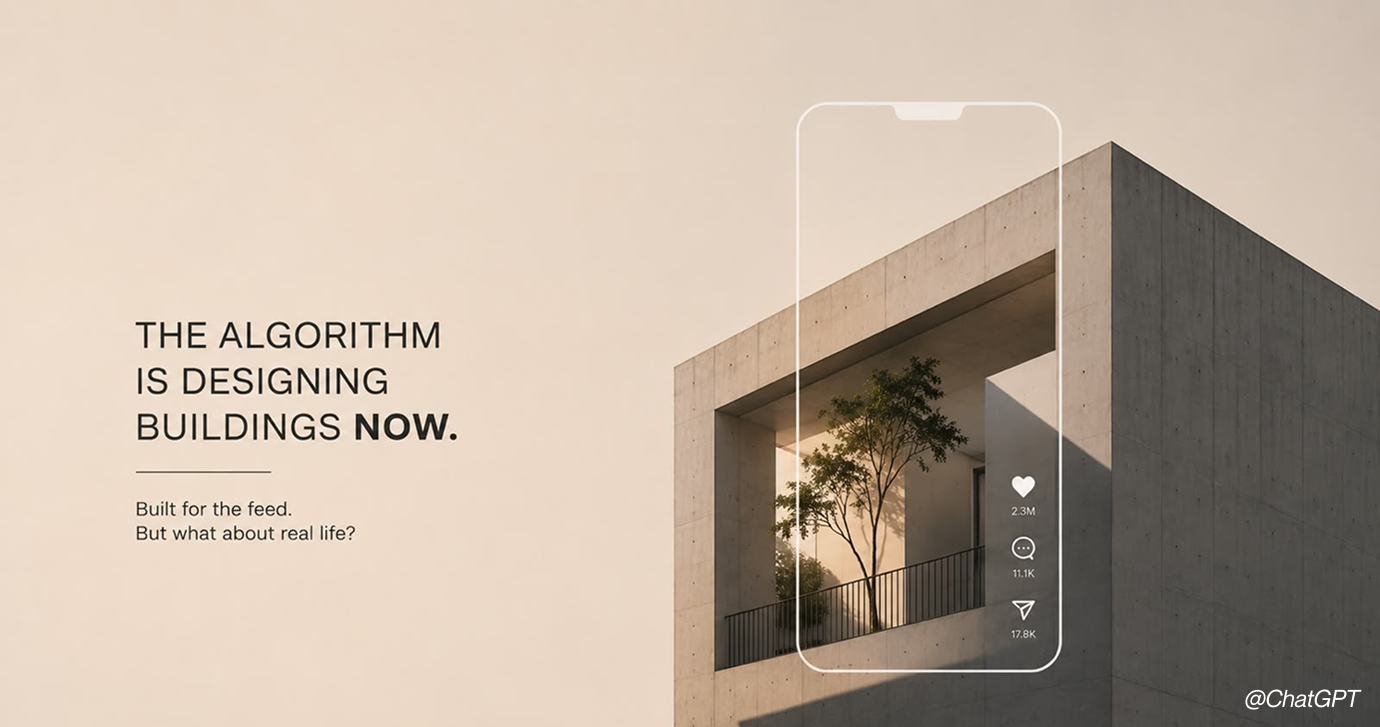
The Algorithm Is Designing Buildings Now
Not because it knows architecture but because it knows what makes us stop scrolling.
An algorithm, in the world of social media, is essentially the invisible system deciding what gets shown to us, what gets pushed further, and what quietly disappears. It rewards what is immediate, striking, easy to understand, and hard to scroll past.
And somewhere along the way, architecture began responding to it.
The Building That Exists Before It’s Built
If a building isn’t photographed, posted, saved, and shared—did it even happen?
A slightly ridiculous question. But also, not entirely.
Today, a building is often judged before anyone has stepped inside it. Before anyone knows whether it is comfortable, functional, climate-responsive, or even pleasant to be in, it has already been cropped into a 9:16 frame and uploaded with a trending audio.
The façade has a good side. The staircase has its moment. And the courtyard? One reel away from becoming a “hidden gem.”
The New Voice at the Table
Somewhere along the way, architecture gained a new stakeholder: the algorithm.
It does not attend site meetings. It does not understand ventilation, material ageing, or why a west-facing glass façade may not be the best idea in an Indian summer. But it does reward what is dramatic, instantly recognisable, and easy to consume in a glance.
And that is quietly changing the way buildings are imagined.
Beauty Doesn’t Always Fit in a Frame
Good architecture has always been aesthetic. It has always understood proportion, composition, light, material, and the power of a beautiful moment. But there is a difference between being aesthetically good and being photogenic.
Aesthetic quality unfolds. It asks you to stay a little longer. It can be felt in the way light moves through a room, how a material changes over time, or how naturally people settle into a space.
Photogenic architecture, on the other hand, has to work immediately. It needs a hero angle. A striking frame. A moment that can hold attention before someone scrolls to the next reel.
Designed for the Lens
Neither is wrong. In fact, social media has made architecture more visible and accessible than ever. A small project can travel beyond its city, reach people outside the profession, and spark conversations that may never have happened otherwise.
But when the image becomes the main idea, the building can begin to perform for the camera before it performs for the people inside it.
A Million Views. Zero Shade.
A project can have a viral corner and still fail the people using it every day. It can have a dramatic façade but no shade. A beautiful double-height space but terrible acoustics. A staircase that looks incredible in photographs but feels like a workout nobody signed up for.
The point is not that buildings should stop being beautiful online. They should. But they should be more than beautiful online.
The Second Life of Architecture
A building now lives two lives. One is digital: framed, edited, shared, and constantly judged. The other is physical: used, weathered, occupied, and full of things no render can predict.
The digital life gets people to notice. The physical life gives them a reason to stay.
The Life No Photograph Can Capture
Because after the reel ends, the post disappears, and the trending audio has been replaced by the next one, the building remains.
It is the life that happens within it: the daily movement, the small pauses, the conversations, and everything that was never part of the photograph.
So perhaps the question is not whether a building is worth sharing but whether it still has something to offer once there is no one left holding up a phone.
Read More
People & Culture
Building today for the womenhood of tomorrow

Architecture
‘Undefining’ Architecture…
- © 2024 SSA. All Rights Reserved.
- Terms of Use